Periodically, UKAS provides technical guidance updates separate to formal publications such as LAB and TPS documents. In the water microbiology testing sector, assessments of accredited organisations have identified some common themes in nonconformities being identified, and where it has been recognised that there is potential for future nonconformity. UKAS is aware of the need to ensure consistency of approach when interpreting ISO/IEC 17025 requirements, and that assessment needs to be conducted in a manner appropriate to the circumstances of individual laboratories. This purpose of this bulletin is to provide guidance specific to the water microbiology sector, and to set out compliance expectations. The aspects included in this bulletin are either currently being routinely assessed during UKAS assessments or relate to mandatory requirements expected to be implemented in the timescales specified in the text below.
If your organisation is unsure of whether requirements apply, please communicate with your Assessment Manager at your earliest convenience.
Legionella isolation and enumeration withdrawn standards
Most laboratories offering an accredited method for Legionella testing follow established conventional standard methods. For several years, UKAS has continued to recognise the withdrawn standards ISO 11731:1998 and BS 6068-4.12:1998. UKAS would not normally recognise a withdrawn standard unless there is no replacement, however the publication of ISO 11731:2017 as an EN, and subsequent British Standard, was voted against by the UK committee for various technical reasons given in the national foreword of BS EN ISO 11731:2017. Additionally, the 1998 withdrawn standards have continued to be quoted in the 2013 issues of Health and Safety Executive Technical Guidance publication series HSG274.
The HSG274 series was reissued in 2024 and updated to recognise BS EN ISO 11731:2017. Accordingly, maintaining a withdrawn Legionella method on scope is no longer considered appropriate (referring to ISO/IEC 17025:2017 clause 7.2.1.3, requiring that “The laboratory shall ensure that it uses the latest valid version of a method unless it is not appropriate or possible to do so”). UKAS therefore will advise laboratories continuing to hold accreditation for Legionella testing based on a withdrawn standard that their schedule listing will be revised to identify the test as an in-house method with a brief summary of methodology. Affected laboratories wishing to make subsequent updates in order to conform to ISO 11731:2017 will need to apply for an extension to scope, giving due consideration to the significance of technical limitations identified in the national foreword within BS EN ISO 11731:2017.
Expectations for alignment with Legionella ISO 11731 “based-on” test methods
When ISO 11731:2017 was originally published, the BS EN ISO equivalent identified concerns around identifying sample matrix type as defined by background flora levels described in Annex J of the test standard. UKAS has applied a pragmatic approach, as the majority of laboratories concluded that filtration with washing, followed by plating out untreated concentrate and prescribed treatments (acid and heat) onto GVPC, offered suitable performance. ISO 11731:2017 identifies BCYE as a required selective plating medium alongside GVPC for waters with low background counts (e.g. water of potable quality).
Subsequent proliferation in the use of intermediary businesses such as facility management companies to sample and submit Legionella water samples on to testing laboratories has diminished the connection between the laboratory and its ultimate customer. Consequently, full knowledge of the nature of the sample matrix received is potentially diluted but the responsibility remains with the laboratory to confirm the sample matrix and media combination used in testing remains fit for purpose particularly for low background matrices if only tested in conjunction with highly selective media such as GVPC (identified as media C in Annex J of ISO 117312:2017).
Accordingly, UKAS is introducing the specific expectation that laboratories demonstrate through periodical re-verification that their interpretation of ISO 11731:2017 continues to deliver the best possible recovery for all sample matrix types received. It should be noted that continued satisfactory performance in internal quality control and proficiency testing exercises will not be considered sufficient, as simulated samples can never be directly comparable in behaviour to naturally contaminated water samples.
In a small number of cases, some laboratories have been accredited against a “based-on” ISO 11731:2017 test method which, following filtration with washing, do not plate out all treatments (i.e. omitting acid or heat treatment processes). While laboratories may well have sufficient validation to support this approach, UKAS now takes the view that this deviation is too far removed from ISO 11731:2017 and as such, schedule of accreditation entries will be revised to describe such test methods as “documented in-house” with a brief description of process and media. Affected schedules will be identified during the course of the month of December 2025, and your Assessment Manager will communicate revised wording for comment ahead of changes being published. If a laboratory wishes to restore its schedule reference to ISO 11731:2017, there will be a need to demonstrate the reinstatement of the omitted treatment, and this will be formerly assessed by UKAS through an extra desktop assessment process. Your Assessment Manager will set out expected documentation to be submitted for assessment.
Testing for Pseudomonas species
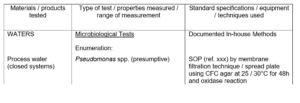
Presentation of water microbiology enumeration testing for Pseudomonas species on UKAS schedules of accreditation remains inconsistent and as such UKAS will be applying the following or similar wording to all schedules. Any reference to Microbiology of Drinking Water will no longer be included as Part 8 is particular to Pseudomonas aeruginosa and requires a different culture media than that for Pseudomonas species recovery. Laboratories have typically developed methods around BS EN ISO 13720:2010 which described the reporting of Pseudomonas species as presumptive following a confirmation of a positive oxidase reaction.
Example water type and techniques will be described as membrane filtration or spread plate with incubations temperature and duration conditions defined.
Inclusion of customer branding on test reports
During assessments, UKAS is seeing an increasing number of water microbiology test reports which incorporate customer branding. This reflects the increasing prominence of intermediary businesses such as facility management companies as customers of laboratories. In general, this approach can remain consistent with ISO/IEC 17025:2017 requirements so long as there is no ambiguity as to the legal entity holding accreditation, where testing was performed and who has authorised the report. Customer branding therefore must not be more prominent than that of the reporting laboratory and this is maybe best achieved by framing the laboratory report with customer brand appearing quite separate rather than alongside. Referring to ISO/IEC 17025:2017 clause 7.8.1.2, “The results shall be provided accurately, clearly, unambiguously” and should the UKAS assessment team consider the presentation of reports featuring customer branding to be misleading, findings shall be raised.
Inclusion of references associated with UKAS accreditation schedule entries
Schedules of accreditation are currently being reviewed for the relevance of referenced publications alongside test method techniques and equipment etc. described. The inclusion of a reference method, or other publicly available document will always be relevant where it provides instruction on the test method followed by the laboratory (so long as it is suitably aligned). It is acknowledged though that for certain areas of water microbiology (particularly around healthcare waters) testing, methodology may be given in basic terms (e.g. brief description of culture media, temperature and time of incubation and reporting limits) but remains appropriate for inclusion on schedules of accreditation, however where publications only give an end result specification or reference a further publication, these are not considered appropriate. We will consult those organisations affected and advised on revised wording prior to update.
Download this Technical Bulletin as a pdf here